
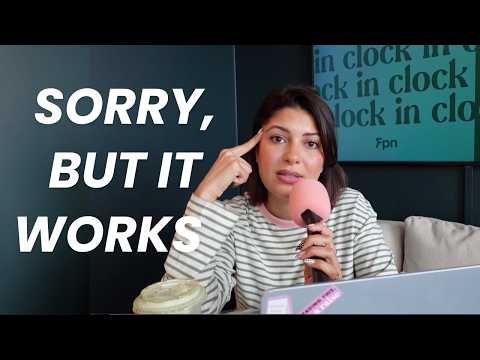


Emily Durham is a former recruiter who makes career advice for millennial and Gen Z women. On YouTube she has 147K subscribers and about 1,300 videos. Across Instagram and TikTok, where she goes by Emily the Recruiter, profiles of her put her at about three million followers. She has a book with Penguin Random House and a podcast.
The part that matters for brands is her collaborations tab. Indeed is on it five times in about two months. Her link page adds LVMH, Microsoft Copilot and Adobe Express. Each of those brands rented one slice of her attention, one video at a time.
This playbook asks what happens if a brand hires an Emily instead: full time, one brand, 30 or more posts a day. Our bet is that it works like any other growth channel, and that the right person costs under $3,000 a month. Below are the seven moves, taken from her account, with how to set each one up and the mistake that breaks it. The case against is at the end, because it's real.

Super Creator by dependables.
- We find and vet a creator with a real credential in your space
- A paid two-week trial before you commit
- Rules sheet and daily posting plan, so nothing waits on approvals
- Weekly numbers review, plus a backup plan if they leave
Run by Stephanie Mendez ›
01 / 07 · THE IDEA
1. Buy a process, not a post
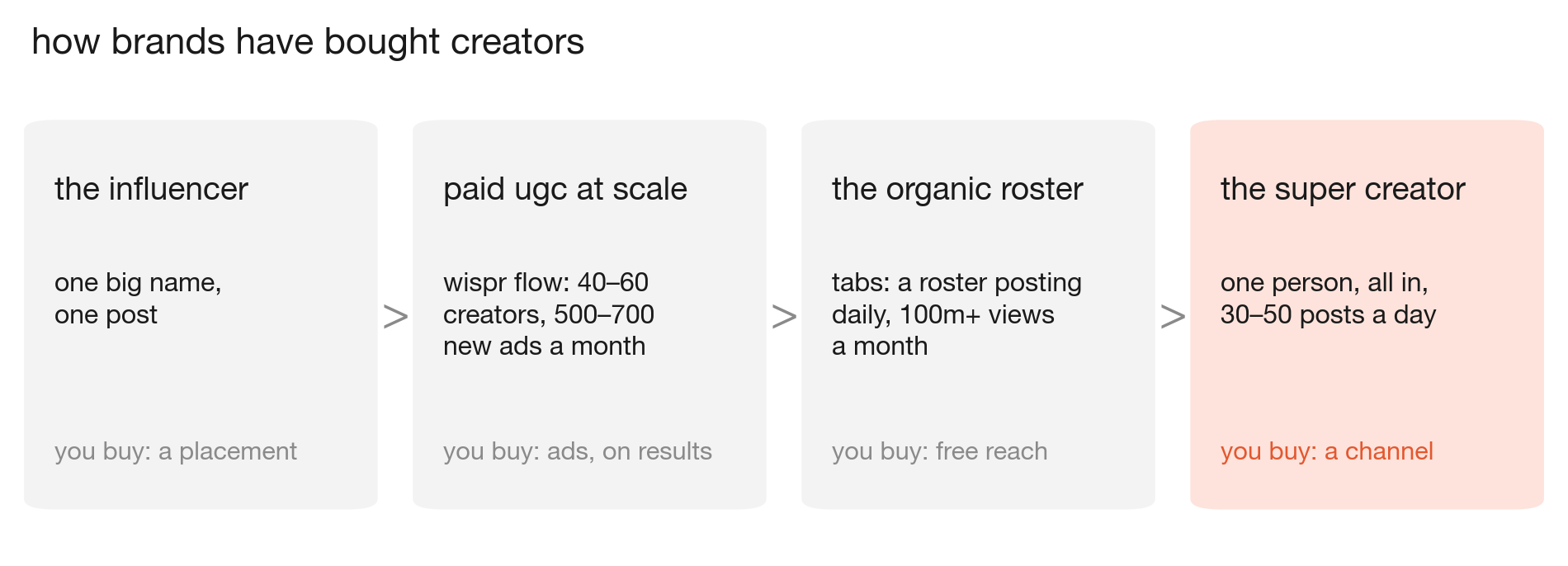
Brands have been walking toward this for years. First came the influencer: one big name, one post. If it hit, great. If it didn't, the money was gone and you learned nothing you could use next month.
Then came paid UGC at scale. Hector Serrano, head of content at Wispr Flow, described their program publicly: start with four or five creators, double to 40 to 60, pay a share of results, and make every video a new idea. As reported, that's 500 to 700 new ads a month. The reach still stops when the budget does.
Then the organic roster. We built one for Tabs Chocolate: creators posting about one brand every day on dedicated accounts. It does 100M+ organic views a month. Most posts get a few hundred views. A few break out, like one reel at 17.7M.
Each step moved the brand away from buying a post and toward buying a process. The super creator is the next step: the volume from Tabs and the variety from Wispr Flow, in one person who learns from every post and whose face the audience starts to recognize.
How to set it up
- Write down what you buy from creators today: posts, ads, or tries.
- Count how many tries you get a month across every creator you pay.
- Check who keeps the learning when a campaign ends. If it's the creator or nobody, you're renting.
- Decide what one full-time person posting every day would replace: a retainer, an ad test budget, an agency line.
- Set a 90-day test window before you judge it, the same as any new channel.
The mistake that breaks it: Judging it like a sponsorship. A super creator is a channel, so the first month's posts tell you about the hit rate, not about the idea.
In the free PDF: Channel math sheet: what you spend on creators today, per try.Get the PDF ↓
A feed is a lottery that pays whoever buys the most tickets and learns fastest from the losers. Renting a creator buys one ticket. Hiring one buys the whole roll.Danilo, from the original essay
02 / 07 · TOPIC
2. Pick one topic your brand lives inside
A super creator doesn't post about your product all day. They post about the one topic your customer cares about, and your product sits where that topic happens.
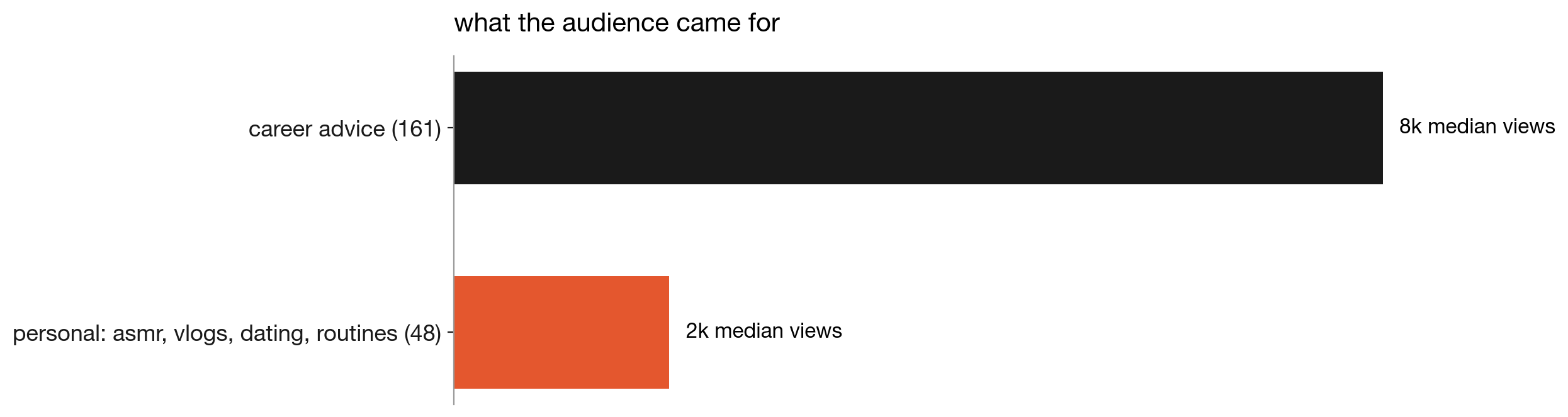
Emily's audience trusts her about one thing: work. When she posted about other things, like dating, ASMR or vlogs, the numbers fell. Her advice videos beat her personal ones for years before her titles caught up.
The topic has to be wide enough for a thousand posts and narrow enough that the audience knows why they follow. Work is wide. Your product's feature list is not.
And it has to stay the creator's account, in the creator's voice. The moment it sounds like a brand account, it stops working.
How to set it up
- List the questions your customers ask before they ever think about buying.
- Group them into one topic a person could talk about every day for a year.
- Check the topic has a place where your product naturally shows up: the link, the tool, the store.
- Keep the account under the creator's name, with the brand in the bio and the link.
- Write one sentence the creator can say about why they talk about this topic.
The mistake that breaks it: Making it a product channel. Fifty posts a day about your product is an ad account with a face, and the feed treats it like one.
In the free PDF: Topic map: from customer questions to one topic and a link.Get the PDF ↓
03 / 07 · HIRING
3. Hire the 2021 version, not the famous one
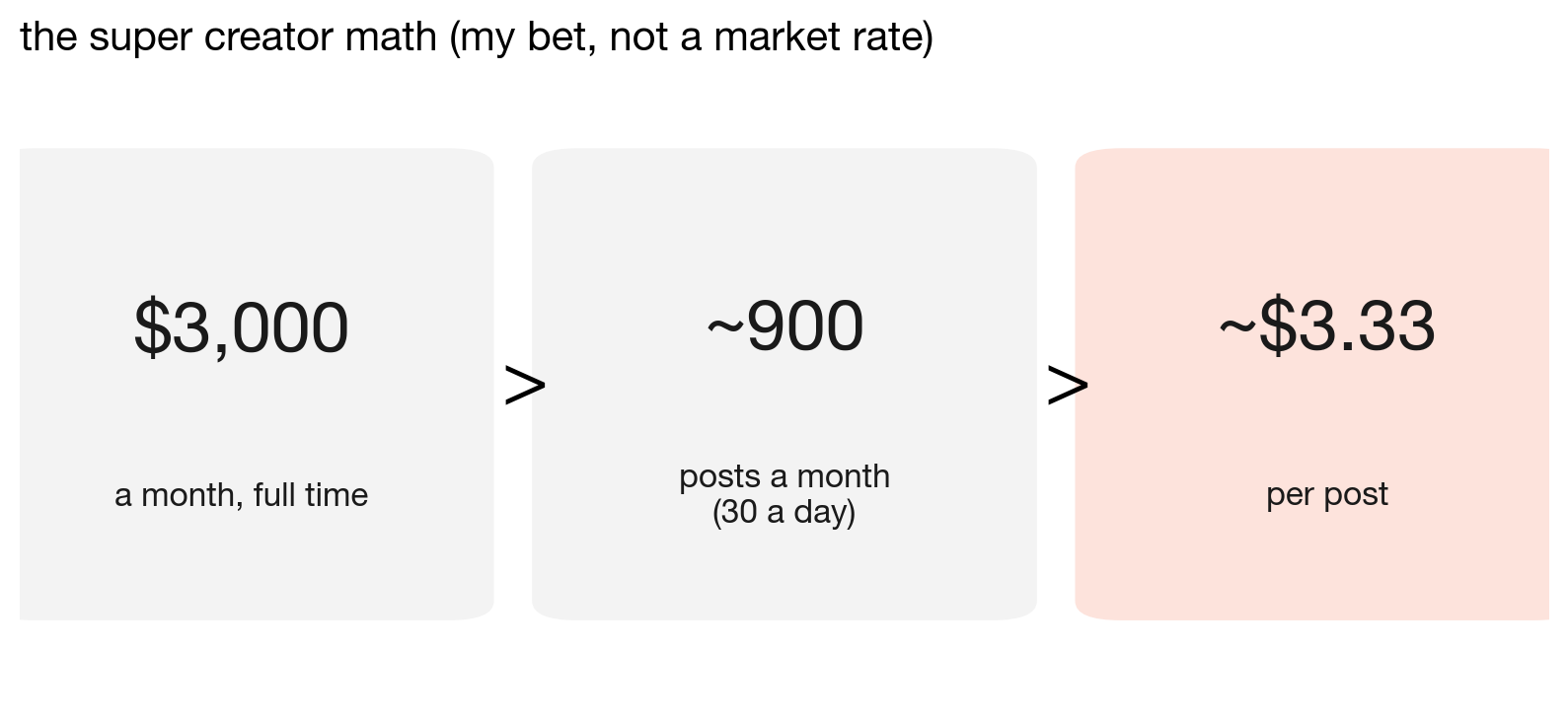
You can't hire Emily for $3,000 a month, and you shouldn't try. She has two books, a podcast and brands lining up. You're looking for the person she was in 2021: an ex-recruiter with a phone, opinions and 3K views a video.
That person exists in every industry. For them, $3,000 a month for doing what they already do for free is a good job. For the brand, it's $36,000 a year. This is our bet, not a verified market rate, and it will vary a lot by country and industry.
You're not paying for an audience, because they don't have one yet. You're paying for learning. Emily needed five years and a thousand videos to find her formula. A full-time person at 30 posts a day runs a thousand tries in about five weeks.
The hire needs a credential. Every one of Emily's best titles leans on it: ex-HR, I've hired 2,000 people. The credential is the first word of the hook. Pay a salary, not a per-post rate, because per-post pay rewards volume over learning.
How to set it up
- Write the credential first: what this person did that makes the audience listen.
- Search for people with that background already posting, with low views and steady output.
- Run a paid two-week trial: 10 posts a day on your topic, no brand mentions.
- Score the trial on range and ease on camera, not on views.
- Offer a salary with a clear posting target and a review at 90 days.
The mistake that breaks it: Hiring for follower count. You pay for an audience you don't need and get someone whose time is already sold to five other brands.
In the free PDF: Hiring scorecard and two-week paid trial brief.Get the PDF ↓
Get the full playbook, with every template
Everything on this page, plus the working pieces you can copy straight into your program:
- Channel math
- Topic map
- Hiring scorecard + two-week trial brief
- Daily posting plan
- Rules sheet (one page)
- Wrapper bank
- Variety grid
- Month-three retention plan
We'll email you about super creators now and then. Unsubscribe any time.
04 / 07 · VOLUME
4. Post like it's a lottery
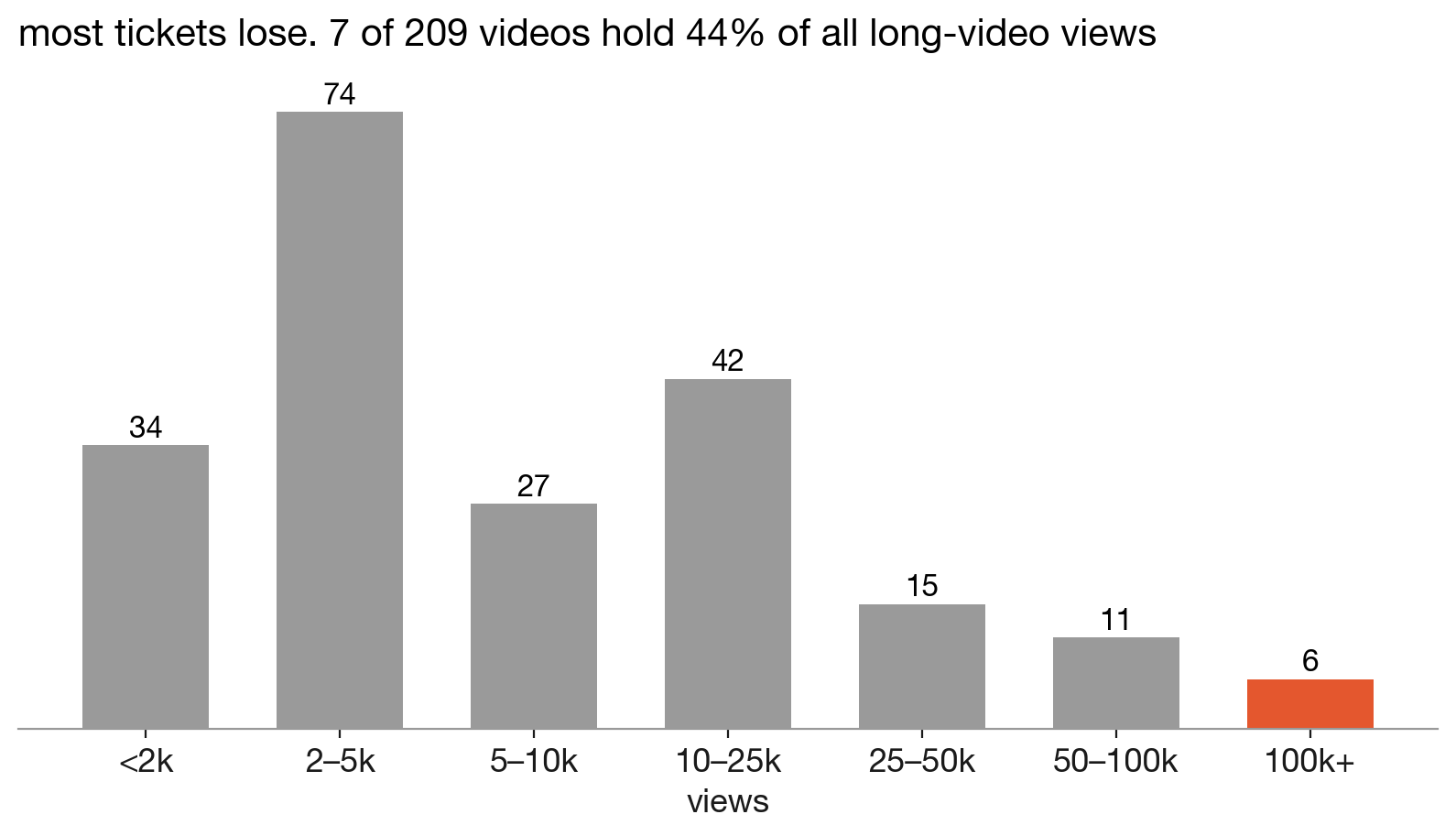
On the old internet, your posts went to your followers in order, and 50 a day would have flooded them. On the feeds that matter now, a post mostly goes to strangers. Each one is its own small audition.
Under those rules a post is a sample, not a message, and samples are cheap. The feed shows each one to a few hundred people and either pushes it wider or lets it die. Most die quietly. A few go wide.
Emily posts about once a day on YouTube, counting Shorts, while running a business, writing books and recording a podcast. A super creator does one thing. The question is what the same person does at 30 a day.
The common advice is one to four posts a day. That number is about a creator's stamina, not the feed's appetite. Most high-volume figures you'll find come from vendors who sell high-volume posting, so test it on your own account.
How to set it up
- Set a daily target to ramp into: 10 a day in month one, 20 in month two, 30 after that.
- Batch filming into two or three blocks a day so the target is a schedule, not a scramble.
- Cross-post to TikTok, Reels and Shorts, and count each platform separately.
- Track one number weekly: posts that broke well above the account's median.
- Never delete flops. They're the data for move 5.
The mistake that breaks it: Treating 30 a day as 30 copies of one video. Near-identical posts get treated as one, so you're running one experiment 30 times.
In the free PDF: Daily posting plan, with the ramp from 10 to 30.Get the PDF ↓
05 / 07 · TESTING
5. Let it flop on purpose
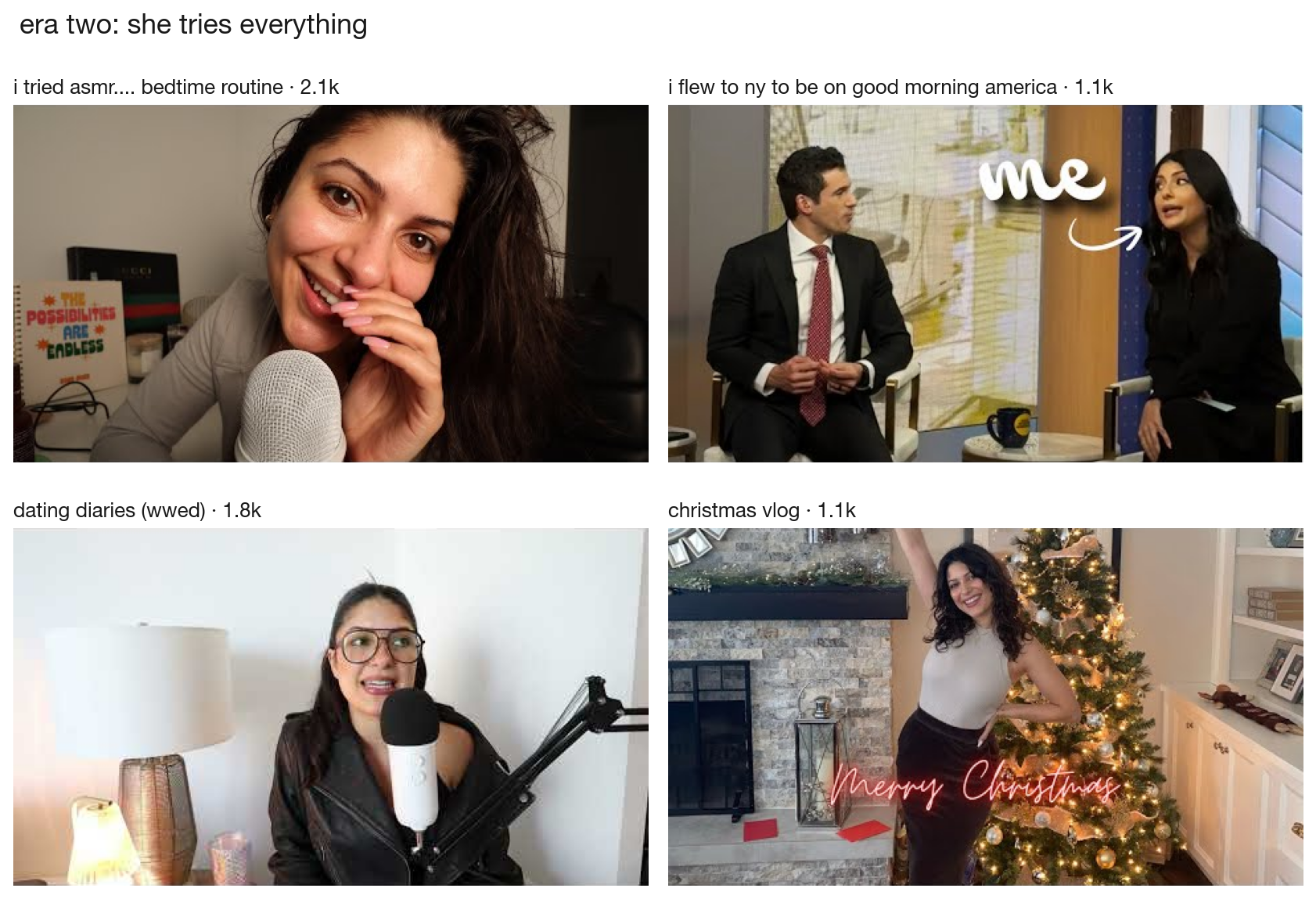
Emily's channel has three eras. In the first, the titles are basically search queries: how to answer 'tell me about yourself' (still at 93K views five years later). Most land between 3K and 10K.
In the second she tried everything: ASMR, vlogs, ask-me-anythings, dating, guest interviews, a 5am routine. Almost all of it flopped. It's also the most useful part of the account.
Those flops weren't wasted. They were the tries that told her what the audience didn't come for. A program built so nothing fails is a program where nobody learns anything.
Most creator programs are built to make each post safe: a brief, an approval, a contract per video. That fits when a post is an ad. It doesn't fit when a post is a ticket. Write the rules up front instead, and let the creator run.
How to set it up
- Write one page of rules: claims you can't make, topics that are off-limits, how to disclose the brand.
- Drop per-post approval. Spot-check a sample each day against the rules page instead.
- Ask for a set share of each week's posts to be formats the creator has never tried.
- Log every flop with one line on what it tested.
- Review the log weekly and cross off what the audience has said no to.
The mistake that breaks it: Running 30 posts a day through legal one at a time. You'll get five posts a day, all of them safe, and none of them will teach you anything.
In the free PDF: One-page rules sheet you can hand the creator on day one (our template).Get the PDF ↓
06 / 07 · FORMULA
6. Find the wrapper
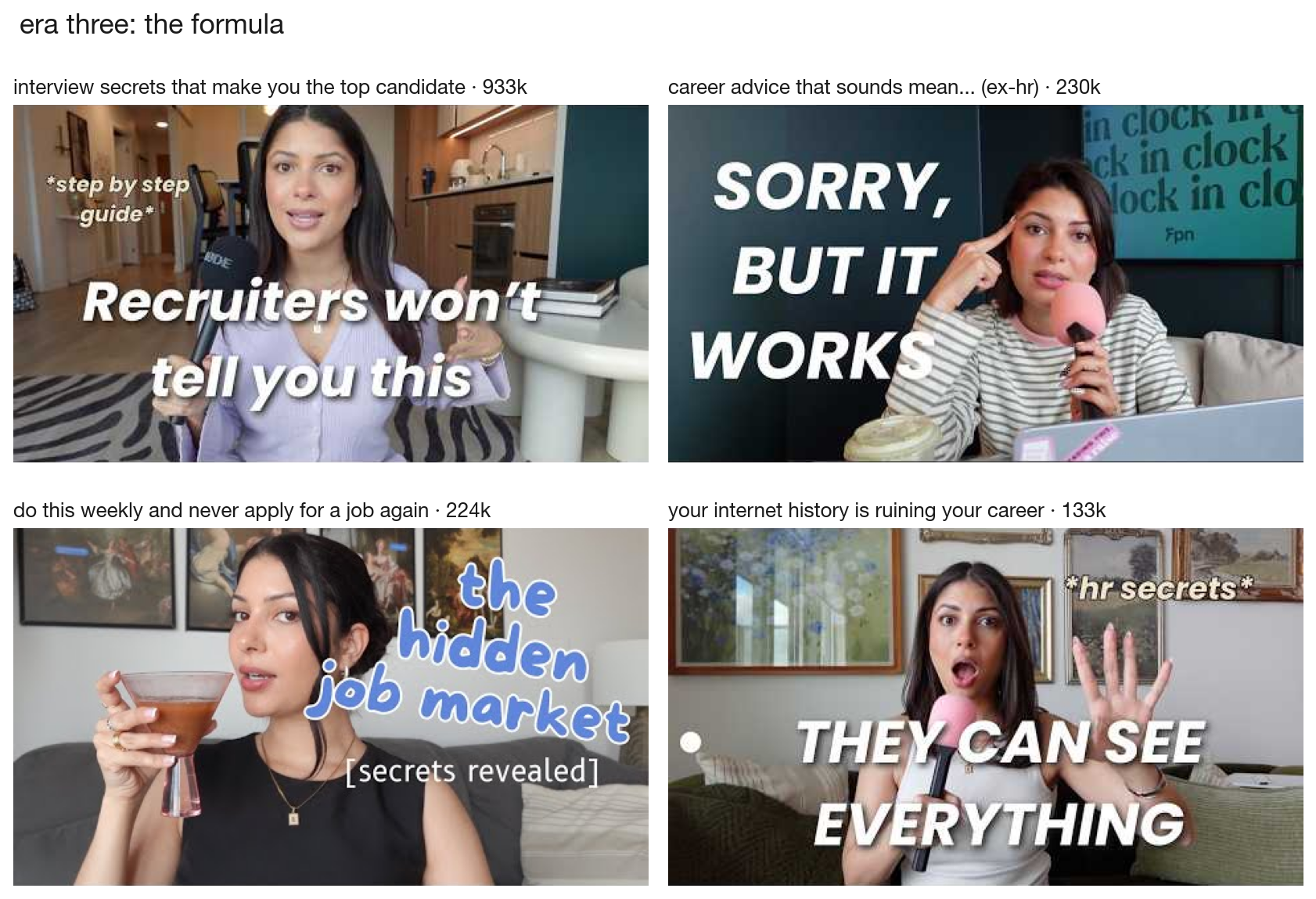
Emily didn't change her topic. She changed the wrapper, and you can see it in the titles.
She put her credential up front: (ex-HR), I've hired 2,000+ people. She made it a secret: things HR won't tell you. She made it a little mean: sounds harsh, tough love, brutal. The advice isn't actually harsh. The promise of harshness tells you she won't pad it.
And she cut what the audience didn't come for. Dating, ASMR and vlogs are gone from the long videos. What's left is one person, one topic, one tone.
Then the formula paid. Six years to reach 80K subscribers, then a month to add 20K. She's at 147K now. The formula didn't make her better. It made her findable.
How to set it up
- Pull the top 10% of posts by views each week.
- Write down the wrapper of each in a few words: credential, secret, tough love, story, list.
- Tag every post with its wrapper so you can compare them across weeks.
- Brief more of what's working, but always as a new post, never a remake.
- Retire wrappers that stop beating the median for three weeks.
The mistake that breaks it: Copying the winning post instead of the winning wrapper. A remake competes with the original. A new post in the same wrapper gets its own shot.
In the free PDF: Wrapper bank: 20 title patterns with examples (our template).Get the PDF ↓
07 / 07 · VARIETY
7. One topic, a hundred wrappers
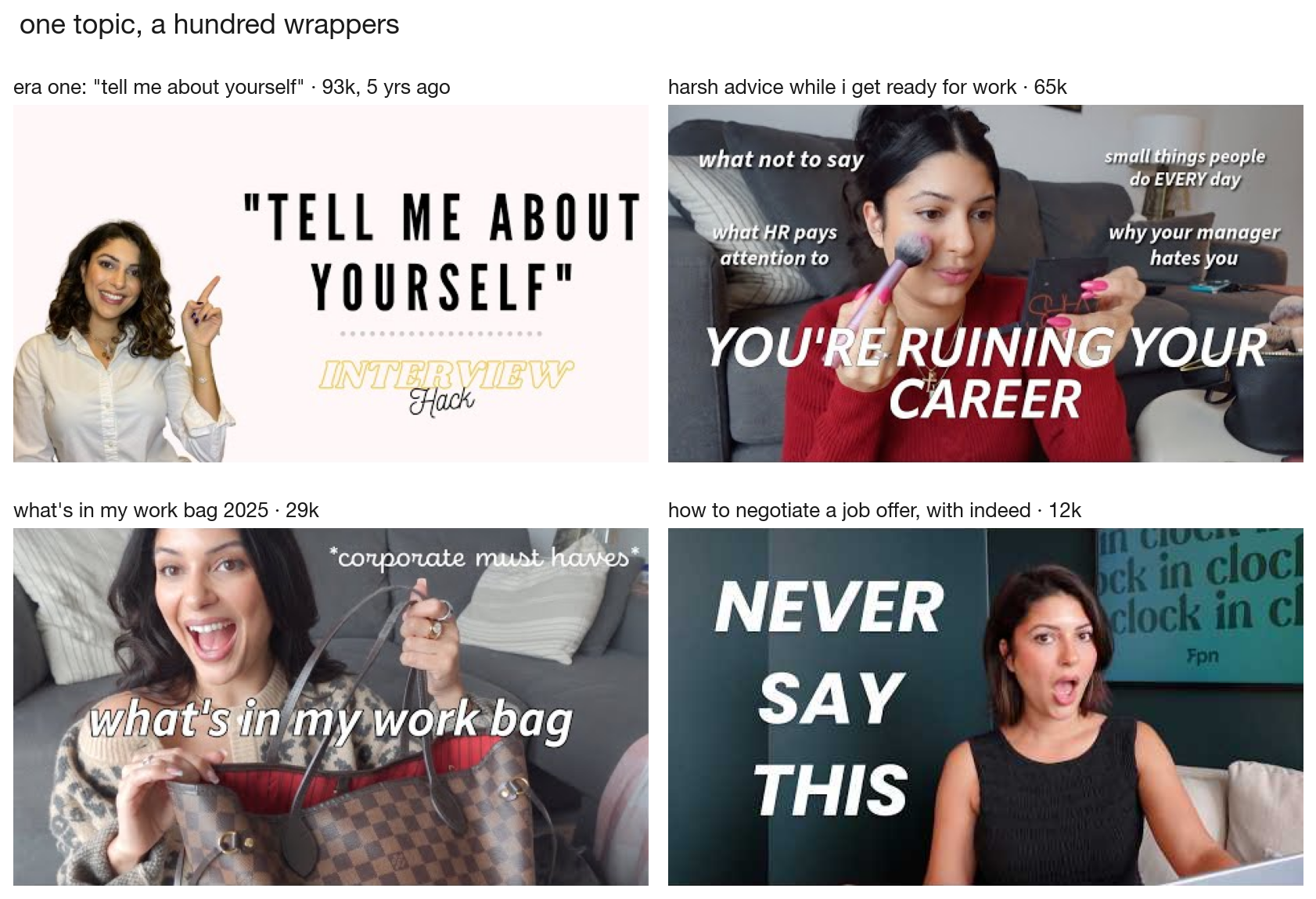
The obvious worry with 30 posts a day is that they'll all be the same post. On Emily's account the topic never changes. Everything around it does.
The format changes: a how-to, a list, tough love, a story, a myth-bust, a Q&A. The setting changes: a get-ready-with-me with career advice inside it beat most of her straight advice videos, twice.
The viewer changes: the new grad, the person getting laid off, the person with a toxic boss, the person who wants a raise. Same topic, cut into a dozen audiences. And the length changes, from a three-minute answer to a forty-minute interview, plus over a thousand Shorts.
Eventually the face carries the post. A haircut Short does well because by now people come for her, not only the advice. That's what years of one topic buys you, and what a brand that hires the creator gets to keep.
How to set it up
- List five formats, five settings and five viewer types for your topic.
- Make each day's posts a mix: no two posts share all three.
- Keep one topic and one tone fixed no matter what.
- Add one personal post a week once the account has a regular audience.
- Re-run the mix every month from the wrapper log in move 6.
The mistake that breaks it: Changing the topic to get variety. Change the format, the setting and the viewer. The topic is the reason the audience trusts the creator.
In the free PDF: Variety grid: format × setting × viewer, with 25 filled-in examples.Get the PDF ↓
THE HONEST PART
The case against
The first draft of this was a fan letter, so here are the reasons it might not work. Plan for each one before you hire.
If you can find the person, write the rules and review the numbers every week, run the playbook. If you can't, that's the job we do: we find, hire and run your super creator for you.
Get the full playbook, with every template
Everything on this page, plus the working pieces you can copy straight into your program:
- Channel math
- Topic map
- Hiring scorecard + two-week trial brief
- Daily posting plan
- Rules sheet (one page)
- Wrapper bank
- Variety grid
- Month-three retention plan
We'll email you about super creators now and then. Unsubscribe any time.
Questions
Is Emily Durham involved in this?
No. We're not affiliated with her and she has never asked to be anyone's super creator. Her posting 30 a day for one brand is a thought experiment. Her numbers are from her public channel.
Is $3,000 a month a real market rate?
It's our bet, not a verified rate. It will vary a lot by country and industry. The point is that you're hiring someone before they have an audience.
Isn't 30 posts a day spam?
On a followers-first feed it would be. On feeds that show most posts to strangers, each post is its own test. Ramp up from 10 a day and watch the median.
How is this different from a creator roster?
A roster spreads the learning across many people. A super creator keeps it in one head, and the audience gets to know one face. The trade-off is one point of failure.
What's in the PDF?
Every move above plus the templates: channel math, topic map, hiring scorecard and trial brief, daily posting plan, rules sheet, wrapper bank, variety grid and a month-three retention plan.
Can you find and run one for us?
Yes. That's what Creator Programs does: we find the person, write the rules, set the posting plan and review the numbers with you every week.
dependables. is not affiliated with Emily Durham, Indeed, Wispr Flow or Hector Serrano. Emily's subscribers, video counts, titles, rounded view counts and collaborations are from her YouTube channel on Oct 30, 2026; brand links are from her link page; we don't know the terms of any deal. The three million is a cross-platform total from profiles of her, not a live count. Wispr Flow figures are as Hector Serrano described them publicly. The $3,000 figure and all templates are dependables' own guidance.
Sources